IN THE BEGINNING
The first time I drank a pint of proper beer in a pub, it came straight out of a wooden barrel on the end of the bar and it was Draught Bass, otherwise known as Bass Pale Ale (4.4% ABV).
This beer was created by a haulier of beer, William Bass, who came into the brewing trade at tender age of 60, which in 1777 was older than the average male life-expectancy He bought a house in Burton-on-Trent which contained a brewery and malthouse on adjoining land, having sold his haulage firm to Pickfords Interesting to note that in those days it was normal practice for brewers to malt their own barley grains, whereas nowadays malted barley is usually bought in from a specialist maltster.
Burton was already a thriving brewing town, when William bought his little brewery, exploiting the growing export trade via the local canal network to the Baltic ports of Russia, mainly St. Petersburg. William established the Bass Brewery, catering for the local market, then in 1784 he started exporting ale to Russia. He died in 1787, aged 71, was succeeded by his sons William and Michael, then in 1795 Michael took the helm and beer production increased dramatically.
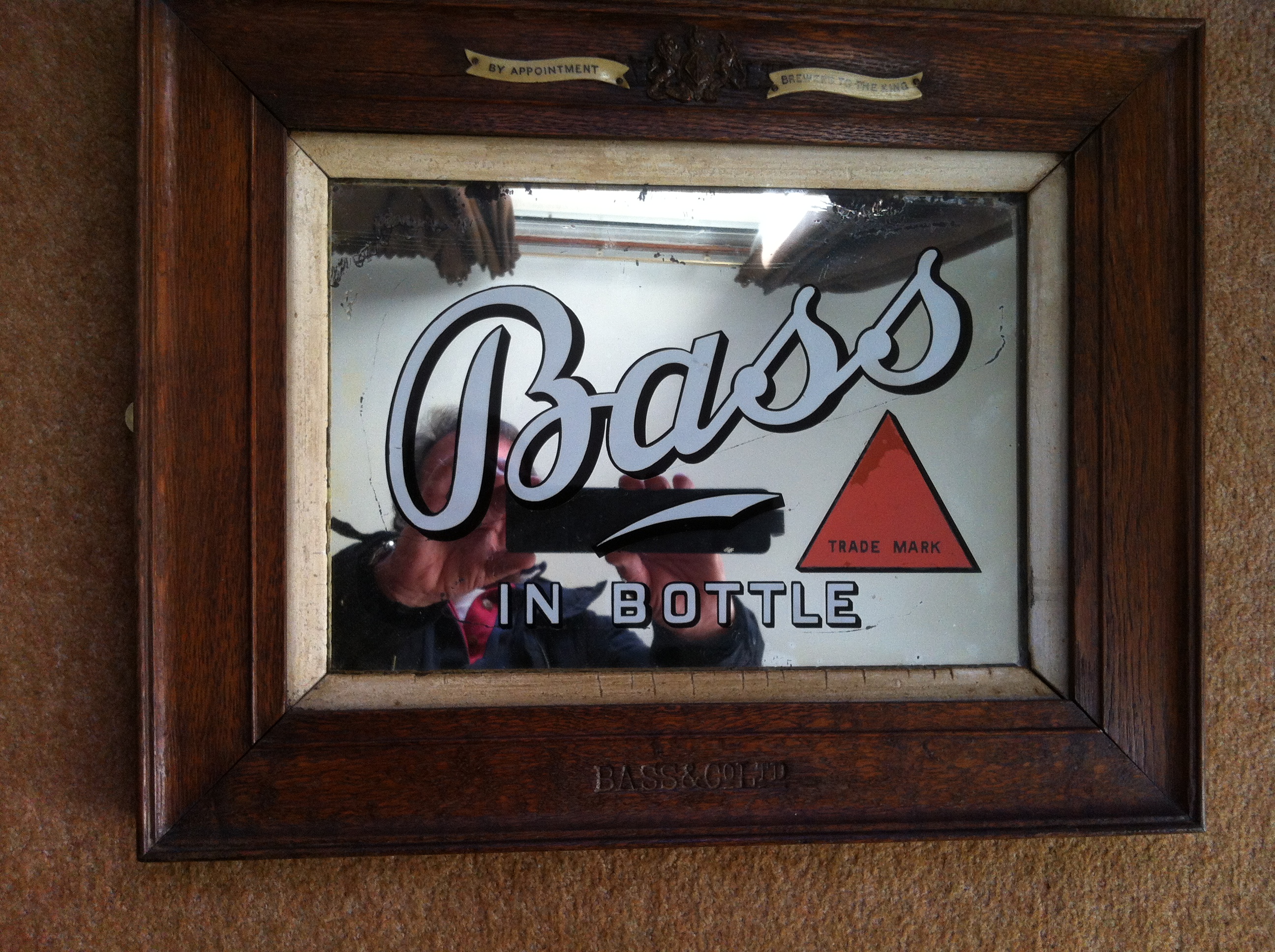
The company’s famous red triangle was the UK’s first registered Trade Mark.
It is common knowledge that Burton owes it eligibility as a beer-making centre to the quality of its water. It stands in a basin surrounded by hills which contain large amounts of the minerals marl and gypsum. The water impregnated with these substances percolates into the underground water system and the sulphate of lime (gypsum) is of importance in brightening beers as it saves on the use of finings to clarify the beer. Also, because of the composition of this water, Burton ales will tolerate larger amounts of hops being added, this being a natural preservative, thereby giving the ales a longer life and more suitable for export in the days of sail. But this water also adds much to the distinctive flavour of Burton brewed ales.
Gypsum is incidentally widely used as a building material in plasters including decorative plasterwork, in mural paintings (including Michelangelo’s Sistine Chapel, in which the painting was done on wet plaster), in medical plasters, in fire protection and in dentistry when false teeth impressions are taken.
To this day, real ales from Burton often exhibit the Burton Snatch, this being a pleasant sulphurous smell exuding from the vent hole of a cask when it is broached in the cellar. Other brewers outside the region may ‘Burtonise’ their ales by adding various salts in the brewing process, but there is no substitute for natural Burton-on-Trent brewing water or ‘liquor’ as brewers call it.
In the early days of brewing in Burton a brewer had only to sink a shaft-well some 30ft deep, but as consumption increased and the water table dropped it was necessary to bore down to a depth of up to 200ft. Controls are in force in the vicinity of Burton to prevent farmers from putting chemicals into the soil that could contaminate this unique water.
THE GLORY YEARS
By the late 1800s, the brewery of Bass & Co was one of the largest in the world and Draught Bass Pale Ale was the biggest selling beer in the United Kingdom by a mile.
The original Bass brewery was built on a plot the size of a modest house garden, but by the end of the 19th century the business occupied an enormous site of over 45 acres.
William Bass had used heavy carthorses over rutty roads to haul barley, hops and other materials into the brewery and barrels out to customers, but by 1880 the brewery had nine locomotives and 12 miles of private railway sidings on site for shipping barrels out to all parts of the country and beyond and had a close working arrangement with the Midland Railway Company. Bass also owned a huge vaulted storage facility at St. Pancras railway station in London.
The company supplied barrels of ale to private families. In 1880 the price for an 18 gallon barrel of Bass Pale Ale was 33 shillings (£1 13s), which worked out at less than 3 old pence a pint, which is a penny a pint in today’s money. The brewery also offered a 5% discount for cash!
In the late 1800s, Bass employed over 2000 brewery workers, with a total weekly wage bill of £2,500, or an average weekly wage of £1 10 shillings (£1.50) per employee.
The brewery was turning out an industrial volume of over a dozen different real ales and consuming a huge volume of coal at the brewery complex.
Their price list included India Pale Ale, six Burton Ales of different strengths including an Old Ale and three stouts, the premium of which was Double Stout.
Barrels were handmade on site from English oak and Bass owned a total of over half a million assorted barrels, the biggest size being butts (108 gallons), then hogsheads (54g), barrels (36g), then kilderkins (18g). In those days the brewery had a large building in which 200 men worked just mending damaged wood barrels. The noise in there must have been deafening.
Interesting to note that the largest size that Draught Bass is now supplied in is kilderkins, which are made of stainless steel and the most common sized barrel now used by today’s micro-breweries is just 9 gallons.
Consumption of draught beer in the UK has dropped dramatically in recent years and there is only a small volume of bottled-conditioned ale sold in our supermarkets.
In 1880 beers from the Bass brewery were bottled by appointed Wine and Beer Merchants around the country, having received wooden barrels of beer from Burton and some of these firms bottled Bass ales for exportation. Bass bottled ale had the Royal Seal of approval.
The history of Bass as a company is quite complex as there were many mergers and buyouts of other brewers over many years and companies absorbed into the Bass empire include :
Charrington, Meakin, H & S, Stones, Walker, Salt, Bell, Worthington, Burton Brewing Co (known then as BBC!), Eadie, Mitchell, Butler, InterContinental Hotels.
Bass supplied beer to customers for over 240 years, but this ended abruptly in 2012 with a letter sent out to publicans by Inbev simply stating : ‘in 28 days time your supplier for our products will be Matthew Clarke Wholesale Ltd’. No apology, nothing !
DISASTROUS POLITICAL INTERFERENCE
The demise of the Bass brewery in Burton was down to political interference in the form of the disastrous ‘Beer Orders’ in the late 1980s, which was ironically supported by CAMRA. The legal proposal was to force all brewers with large tied estates to reduce them to just 2,000. And yet all of these large tied estate public houses had been purchased at market value or above over many years, so this was grossly unjust.
In my capacity as a CAMRA Life member, I had a letter published in CAMRA’s monthly newspaper, What’s Brewing in 1988, in which I condemned their support for the Beer Orders, arguing that if they expected the thousands of brewery tenancy pubs to switch to free houses, that this was most unlikely to happen. I argued that the big tenanted estates were on the whole successful and were owned by old-established brewers who knew the trade inside out.
Bass owned more pubs than any other brewer in the UK. Their estate of about 9,000 pubs was the best of all of the brewers’ estates and contained some of the finest hostelries in all of the provinces of the UK, including many historic Listed buildings. It was this large estate of brewery-tied public houses that kept the Brewery intact at Burton and it kept Draught Bass on the bar throughout the country. The same argument applied to the other large breweries that were to be affected. But Parliament voted in this misguided retrospective legislation ordering all brewers to reduce their estates to 2000 tied houses maximum. So Bass, like most of the old-established brewers with large estates having been sold down the river by meddling politicians, predictably decided the best option was to sell out, as their excellent companies were effectively to be legally dismantled.
David Young (Baron Young of Graffham) spearheaded the Beer Orders for the Tories. David was forced to resign as an enterprise advisor to David Cameron in 2010 when he declared in the Lords that (even in the depths of a Recession) “We have never had it so good”. He also stated more recently that the loss of 100,000 state sector jobs was in “an acceptable margin of error in the context of a 30m strong job market” ! Then in May 2013 he stated that a recession is a good time to start a business as it is cheaper to take on workers ! So much for his credentials. The groups of individuals that were not deemed worthy of consultation by David Young were the working publican-tenants, their employees and the huge workforce at the breweries with estates greater than 2,000 tied houses. Perhaps Lord Young was oblivious to the glaringly obvious reality that the Beer Orders would put many of these hard-working people on the dole. Maybe he acted in good faith but had just not done his homework. What on earth did this Tory millionaire former public-schoolboy know about our precious pubs and breweries anyway? His legislation inadvertently put many tens of thousands of tax-paying workers on the scrap heap.
THE FALLOUT FROM THE CRAZY BEER ORDERS
The net result of this political interference, and the Conservatives’ (and CAMRA’s) disastrous legacy, was that the big brewery-owned estates were taken over by private equity-funded Pub Companies a.k.a. Pubcos, who were not only allowed to tie their tenants, but offered them what have turned out to be mostly toxic leases and charged them way over the odds for their wet goods. The new pub companies were also allowed to own unlimited numbers of pubs, which made a mockery of the 2000 retrospective threshold imposed on the brewers.
A typical new Pubco lease was for a period of 25 years, assignable after a couple of years. Yet common sense dictated that most licensees do not last long-term and that the former 3 year brewery tenancy agreements were much more suited to publicans. A former Bass pub manager told me that the Bass tenants that he knew personally who opted to sign leases with Punch Taverns, or get out of their tenanted pubs, lost ‘everything’.
This Pubco model, fuelled by corporate greed, was absurd and has failed miserably, leading to the unnecessary closure of thousands of potentially viable public houses. The only substantial beneficiary of the Beer Orders is the Wetherspoon managed chain, as they can sell their beer cheaper than some Pubco leaseholders can buy in for. Brewery tenants who switched to Pubco leases were metaphorically thrown to the lions.
When the old Bass tenanted estate was still intact, I am reliably informed that there was always a waiting list of carefully vetted tenants for their pubs. However, when the Pubcos started dishing out their long leases, it became a common site to see viable pubs boarded up and patently obvious that many of their new leaseholders were not cut out for the trade, but had simply stumped up the dosh to enter into a lease. I can not recall seeing any PUB TO LET signs prior to the Pub Companies springing up. They really screwed things up.
The wretched Pubcos even installed beer-monitoring equipment into their pub cellars to ensure that their tenants did not buy outside of their iniquitous tie, yet none of these pub-owning companies brewed a drop of beer between them.
To this day, it beggars belief that non-brewing pub companies are still legally allowed to tie their tenants to their own list of beers and to charge them way over the odds for the privilege. This has got to be a breach of the tenant’s Human Rights and non-brewers ties should be abolished.
The Pubco tenant places his order with his non-brewing landlord, who then debits his bank account before the goods will be delivered. That is a common scenario and is appalling. The big breweries gave their tied tenants a much better deal before the Beer Orders came in.
I was recently shown two price lists by a northern micro-brewer – one for the free trade and the other for Pubco tenants. In round figures, the tenants were being charged twice as much as a free house by their Pubco for the same beers and yet the brewer sells to the landlord at rock bottom discounted price, so the Pubco gets the best of both worlds : high rent and high profit on the beer, while the tenant struggles to make ends meet and usually goes bust.
Punch Taverns acquired the Bass portfolio of tenanted public houses in 1997. This new company was established by former Pizza Express supremo Hugh Osmond and Cafe Rouge founder Roger Myers.
The Beer Orders were revoked in January 2003, by which time irreversible damage had been done to the UK pub and brewery industries, with many, many job losses. Needless to say, there was no apology from any politicians or from CAMRA for getting it wrong. IF THE BEER ORDERS HAD NOT COME IN, THE PUBCOS WOULD NOT HAVE BEEN CREATED. One consolation however is that several of Pubcos have gone into Receivership and some others are deep in debt and on the way out.
THE DEMISE OF THE BASS BURTON BREWERY
There is now no Draught Bass brewed at the old Bass brewery in Burton, which was acquired by US giant Molson Coors in recent years, and where they now primarily brew Carling Lager. Molson do not own the Bass brand, which was sold to Belgium brewers Interbrew.
Bass is currently brewed under contract from Inbev by Marston’s Brewery in Burton, so at least it is still made using the same brewing water and by a old-established Burton brewery, using the finest ingredients under the guidance of highly qualified brewery personnel, some of whom worked in the old Bass brewery.
Draught Bass is the No 1 selling ale at my pub. Bass drinkers are surprisingly loyal to their product, as it still one of the finest beers brewed in the UK. It’s all down to the flavour, as well-kept Bass is in a class of its own.
Many of today’s modern boutique brewery ales are thin pale offerings brewed in small industrial units and some of these so-called real ales, often brewed using fluoridated mains water are little better than home-brewed kit beers. However, to their credit, some of the new breed of breweries are turning out good quality, full-bodied, traditional ales.
Even back in the 1800s, university-educated industrial chemists were employed by Bass, as malting and fermentation are extremely complex chemical processes that have to be carefully monitored by experts at all stages. So impressive was the Bass set-up that microbiologist Louis Pasteur visited the brewery to cast his eye over proceedings.
To learn more about the history of brewing in Burton on Trent, visit the Museum at the National Brewery Centre in the old Bass brewery in Burton on Trent, which to their credit Molson Coors have funded, although they did close it for a while after buying the brewery. They have also installed a small real ale brewery for the production of Worthington cask ales.
REFLECTIONS OF A BASS DRINKER
So what is the difference between modern day Bass and the draught product of yester-year? About 30 years ago Bass stopped using the Burton Union System, which they invented and which was credited with maintaining the unique strains of their Brewers’ Yeasts in a stable state until the mid 20th century. The Union System was a row of large wooden barrels in which the beer was fermenting, connected by swan-necked pipes to a common trough above into which rose the excess yeast, pushed up by carbon dioxide gas (as yeast multiplies during fermentation and carbon dioxide is a by-product of fermentation) and which separated from beer in the troughs, the ale returning to the casks below to continue fermenting. Surplus yeast was removed and sold to make the likes of Yeast-vite tablets, these being rich in Vitamins B1, B2 and Nicotinamide, but some yeast was always retained for future brews.
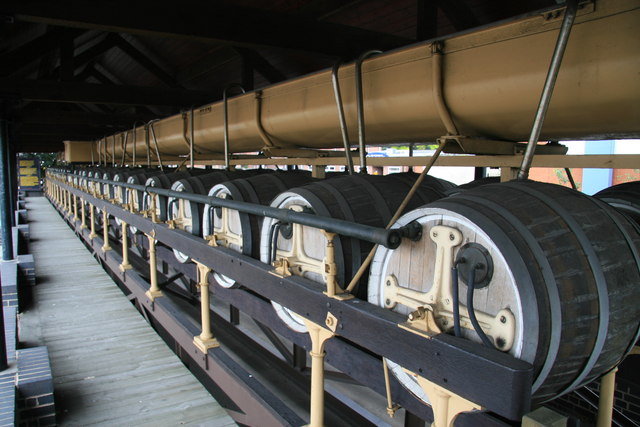
Burton Union fermentation system, Coors Visitor Centre
Nothing is wasted in the brewing process, with spent malted barley used as cattle feed and spent hops finish up on fields as a soil conditioner.
When Bass ceased to be brewed using the Unions, there was a marked change in the character of the ale, which was lamented by devotees of the beer, myself included. Union brewed Bass had a pleasant “sulphury” flavour and a fuller taste, but it has to be said that overindulgence gave rise to extreme flatulence, for which Draught Bass was infamous and which was the subject of many a pub joke. Also, Bass was often seen to be served slightly cloudy if put on sale prematurely, as Union-brewed bass had a very heavy sediment and needed two or three days to settle. Elderly Bass drinkers tell me that they used to flock to the pub where the Bass was said to be in the best condition on any given day.
The Burton Union System is a brilliant system for separating the yeast from the wort, but far from being just a yeast-clarification mechanism, the Unions also deliver more robust and flavoursome beers than other real ale brewing plant.
Draught Bass was a ‘must stock’ product in many pubs and in the North East of England many Newcastle Brewery houses sold Bass and by reciprocal agreement some Bass houses stocked Newcastle Brown Ale, which in those days was also a superb product.
Marstons-brewed Bass has a superb if slightly modified flavour, but is brighter in character and with a much lighter sediment in the barrel, which bodes easier on the stomach. It is still brewed to the old Bass recipe using two unique strains of brewers’ yeast, which contributes greatly to the flavour of the ale along with Burton water and finest English hops and malted barley.
Marstons brew Bass using traditional Yorkshire Squares (as used by Black Sheep Brewery) which is a two deck system: The liquid extracted from the malted barley (the sweet wort) is fermented in the lower chamber, while the yeasty head settles above and during the first stage of fermentation the fermenting wort is pumped from the bottom chamber over the yeasty head to keep the yeast well mixed with the wort. In the second stage of fermentation the wort in the lower chamber is allowed to settle and cool gently and most of the yeast rises to the upper chamber and is left behind when the fermented wort (beer) is drained off. This process takes at least 6 days.
Beer straight from the Yorkshire Squares can be a bit harsh in flavour and so the residual yeast in it is allowed to ferment any remaining sugar, producing a mellower and more robust beer. The final slow fermentation takes place in tanks in the brewery and continues after the beer is put into barrels, hence the term ‘cask conditioned beer’.
The Squares were originally constructed from Yorkshire sandstone, but Welsh slate proved to be more suitable. A modern version, as used by the Black Sheep Brewery in Masham, is circular and made of stainless steel.
Burton Unions and Yorkshire Squares both extract maximum flavour from a brew and are greatly superior to less complex modern brewery plant used today. The Unions, however, have the edge when it comes to the end-product and they were widely used nationwide many years ago, but are an expensive and complex way of brewing beer.
Although Marstons are now brewing Bass in Yorkshire Squares, it is now the only brewery left in the UK that still uses the Burton Union System for brewing some of its own beers. Marstons are to be applauded for keeping their Burton Unions intact. It is just a shame that Marstons do not brew Bass in their Unions, as this would regenerate a huge amount of interest in Draught Bass and return the character of the beer to its former glory.
FURTHER AFIELD
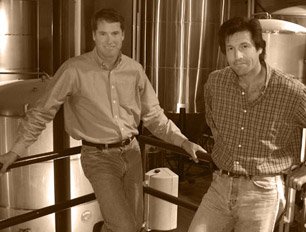
Another brewery that has invested heavily in a Burton Union System is the Firestone Walker Brewing Company in Paso Robles, California. One of their directors, David Walker, was aware of the exceptional quality of Burton Union brewed ales from the Old Country. Brothers-in-Law Messrs. Firestone and Walker set up their brewery in 1996 and believed that the perfect pint could be created in 60 gallon oak barrels.
Sure enough it has paid off handsomely, producing rich and complex ales. Paso Robles (full name El Paso de Robles ‘The Pass of the Oaks’) is a small city more famous for wineries and hosting of the California Mid-State Fair. It is located about halfway between LA and San Francisco in the county of San Luis Obispo. As far back as 1795, Paso Robles was described as California’s oldest watering place, because of the excellent quality of its natural mineral water – so a lot in common with Burton on Trent and a good reason to visit the Firestone Walker Brewery in sunny California! Brewery Website : www.firestonebeer.com
FAST FORWARD TO 2013
Modern-day Draught Bass is now clear at the barrel tap within a few hours of being delivered. But like all real ales, it needs to be sold quickly to ensure a healthy turnover of barrels and no real ale is in tip-top condition if the barrel is on sale for more than about 3 or 4 days.
It is to be hoped that global brewer Anheuser-Busch Inbev, which owns the Bass brand, will see fit not to discontinue this most famous of all English beers. An optimistic scenario would be for Molson Coors to buy the Bass rights from Inbev and to resurrect it at their Bass Brewery in Burton on Trent, as surprisingly the historic brewery complex is still intact. Failing that, perhaps Marstons could conceivably acquire the Bass brand and continue brewing it long term.
The future for Draught Bass is uncertain.
Hugh Price (hughprice@hotmail.co.uk)
Tynemouth Lodge Hotel, public house.